Pool is a game which was derived from billiards in the 1870s, with the history of billiards never having been very clear as to its exact origins. Shakespeare mentioned billiards in his play Antony and Cleopatra in 1600 which has lead to the assumption that the game originated sometime in the 15th century. It is widely believed although no one can prove it that the game originated from the game of croquet which for those of you who have not heard about this game here is a brief summary.

Croquet is a game played on a grass lawn that was popular with the aristocracy in Europe in the 15th century. It involves striking a solid ball which is 3 5/8" in diameter through hoops which are referred to as wickets. The standard game used nine wickets but variations of the game can see this number change. The balls are struck with a mallet which is designed in length so that no bending over is required when playing the game. Because this was played outdoors often the weather meant that play was not possible and at some point an indoor version was created using a bumper edged felt covered table to resemble a lawn and small balls were pushed through hoops with a stick. This is believed to be where the game of billiards began in France where croquet was very popular and the word billiards was derived from two French words "billart", a wooden push stick and "bille", a ball.
Billiard Balls
Although the exact time is unclear later in the 1600s the cue as we call it today replaced the mace which was the name given to the push stick which did not have a tapered end. Sexism came in at this point as it was deemed that women would rip the cloth trying to use a cue and they were made to continue using the mace. The first rule book for billiards was published in 1675 and the game steadily grew in popularity throughout the 1700s with no noteworthy advances or changes taking place until the 1800s.
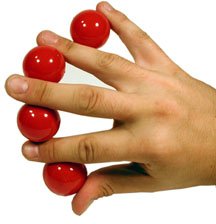
A classic of magic! One red ball, held at the tips of the fingers, suddenly multiplies to two. At the magician's command, another ball appears, making three. Finally, a fourth ball makes its appearance - one between each finger of the hand. Teaches the fundamentals of sleight of hand without challenging the beginning magician tremendously. A minimum of practice required. Manufactured by FUN Inc. in the USA. Detailed directions included.
- A classic of magic!
- One red ball, held at the tips of the fingers, suddenly multiplies to two.
- At the magician's command, another ball appears, making three. Finally, a fourth ball makes its appearance - one between each finger of the hand.
- Teaches the fundamentals of sleight of hand without challenging the beginning magician tremendously. A minimum of practice required.
- Manufactured by FUN Inc. in the USA. Detailed directions included.
Please Check Update Here!!!

- Instant Appearing 18 Inch Magic Wand
- Disintegration Chamber From Royal Magic - A Red Plastic Ball Simply Melts Away!
- Empire Magic In and Out Box - Impossible Magic!
- Dime and Penny Disappearing Illusion Magic Trick
- Empire Magic 2" Red Sponge Balls
The 1800s saw the introduction of cue chalk before tips were even used, as it was found to increase the friction between the ball and cue, resulting in a more efficient strike of the ball. The cue tip was introduced in Britain in 1823 and was made of leather and this changed the game as skilled players could now apply spin to the cue ball for more control. This was perfected amongst British players and they referred to it as putting side on the ball. This skill was passed onto American players who often refer to it as English because it originated in Britain. Two piece cues were produced from 1829 and were an instant success as they could be easily carried whereas previous cues were awkward because of their length. The early 1800s saw more advancements in the game than any other time period due to the industrial revolution. Coming next were slate beds introduced from 1835 and when Goodyear perfected the manufacture of rubber it was incorporated into the cushions from 1845.
Until the 1870s, four ball billiards was the most popular game in America but that all changed with a new spin off game called fifteen-ball pool. This game very quickly became the most popular and from it the other versions of pool were created. In Britain pool caught on a lot slower, as in the 1920s snooker became the main table game and is still widely popular there today. Pool is now more popular than snooker for participating in, although as a spectator sport snooker still takes top position in Britain.
Pool - The Game's Origins